
STORIES: Sylvia Plath
Marco Mandrino
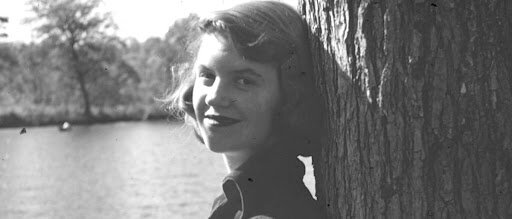
There are moments when reading Sylvia Plath is like being embraced by a friend. Others when it reopens wounds. Others still when it heals them. In her company, there are certainly never moments without emotion.
Sylvia's story is very well known: a far from easy life, marked by severe depression and complicated relationships, among them the one with Ted Hughes, also a poet, but also an unfaithful and violent husband. And a sad ending with suicide at just thirty.
Sylvia's poems are as intense as her life. The darkness she carried inside like a heavy, cumbersome piece of luggage emerges powerfully in her verses. She is not delicate, but extremely direct. She uses visceral, concrete, at times almost violent words.
A woman with a difficult life, yet one who was able to communicate in such an emotional and universal way that she became a reference point in modern and contemporary poetry. I detest those who say "despite" being depressed, "despite" being ill. There is no despite: her uniqueness comes from that too, and feeling close to her comes through all the fragility and complexity of a soul in eternal conflict, which is, after all, the soul of many. There are not only words of love, not only delicacy and sweetness; these are clichés about women's artistic work. No, here there is access to an entire world, certainly made of light, but also of shadow. So much so that her last collection of poems, Ariel, published posthumously by her husband, was subjected by Ted to an unjust and probably highly self-interested "cleaning up" and purging of her verses, which he considered too extreme. This tells us a great deal about how much Sylvia's poems could frighten, and how unique her work was: so distinctive, singular, powerful, against the grain. And for this reason too, Sylvia today is a symbol for many women, a point of reference, a role model.
One of the things that strikes me most about Plath's poems is her ability to bring her emotions, her humanity and her ever-changing moods out clearly and strongly. In her books there are moments when it feels like you are travelling across a tumultuous sea, sometimes calm and welcoming, many other times impetuous, frightening, at others violent, at others simply and immensely black and sad. And you can tell from her words when the blackness became heavy, unbearable for her. Here is a poem I adore, a drop from her stormy sea.
I Am Vertical (1961) by Sylvia Plath
But I would rather be horizontal.
I am not a tree with my root in the soil
Sucking up minerals and motherly love
So that each March I may gleam into leaf,
Nor am I the beauty of a garden bed
Attracting my share of Ahs and spectacularly painted,
Unknowing I must soon unpetal.
Compared with me, a tree is immortal
And a flower-head not tall, but more startling,
And I want the one's longevity and the other's daring.
Tonight, in the infinitesimal light of the stars,
The trees and the flowers have been strewing their cool odors.
I walk among them, but none of them are noticing.
Sometimes I think that when I am sleeping
I must most perfectly resemble them —
Thoughts gone dim.
It is more natural to me, lying down.
Then the sky and I are in open commerce.
And I shall be useful when I lie down finally:
Then the trees may touch me for once, and the flowers have time for me.
Alice K.
STORIES is a column dedicated to great stories from the past that can inspire your present.