
Saturno Buttò: pleasure and pain
Marco Mandrino
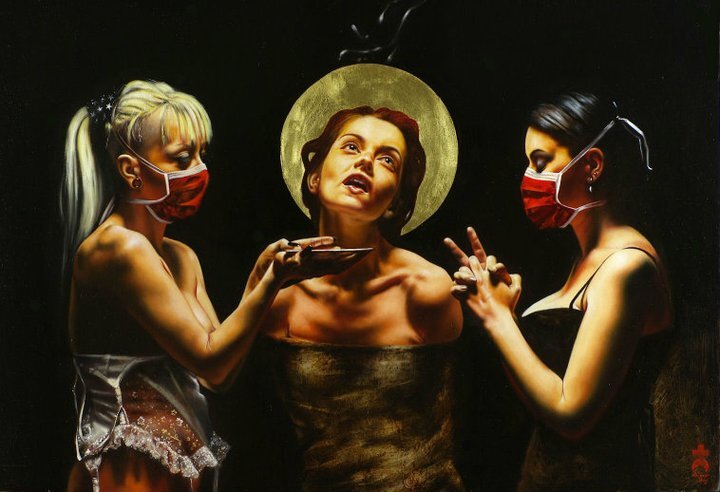
Curated by Alice Kundalini - She Spread Sorrow
Saturno Buttò is a Venetian artist born in 1957 in Portogruaro, with an irresistible aesthetic. Sacred and profane, mystical ecstasy and transgression, religion and fetish: with his incredible and extremely "classical" technique, in which the main reference is sacred art, Saturno Buttò builds on the materiality of the body, the human body, especially the female one, so despised by the Christian tradition, which finds in it only temptation and sin.
And this is what Saturno Buttò represents in his works, making it the central aspect of his art. It is no coincidence that one of his most celebrated solo exhibitions is titled Eretico/Ieratico.
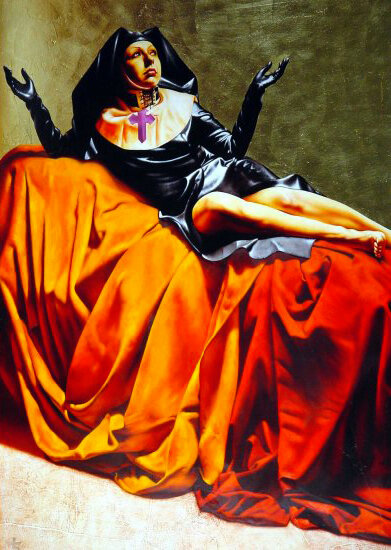
Christianity lives on this deep fracture: it disowns what is human in a constant referral to the divine, which is totally beyond, totally elsewhere. Compared with pagan traditions or other religions of a pantheistic stamp, Christianity, with its "extreme" transcendence, defers everything to after life, beyond the world, without the body. An absolute spiritual dimension. Deferring everything to the beyond brings with it a further step, which is the negative value placed on everything that belongs to this side. Christianity does not merely make us wait for the afterlife, but stigmatises, in an extremely peremptory way, everything that comes from physical, natural, bodily, human sensations. So the body is evil, pleasure is evil, sex is evil, enjoying a good plate of food is evil, even fantasising about pleasure is evil. Woman, of course, is among the greatest evils in the absolute sense: temptress, sinner, cause of the end of the earthly paradise. And she is a body that generates a body after a sexual act, thus casting this perverse shadow even over what is most natural and necessary to humankind, such as pregnancy and the generation of life. And finally, to cap it all, since everything natural is defined as sin, yet being natural it is unthinkable to be a stranger to it, here comes the cherry on the cake: guilt. And consequently shame. And consequently punishment.
What is extremely contradictory, but also extremely fascinating, about Christianity is that this constant aspiration to the Spirit is translated into narratives that are, instead, extremely "material". That is, this so transcendent religion has a son of God, a man, who ends up on a cross. We are shown thorns entering his flesh. Nails piercing his hands. A spear tearing open his side. We walk into a church, look around, and this is what we see. Bleeding bodies, crucifixions, stigmata, torture, wars, violence. And very often not only that: bones, skulls, mummified saints. And the Eucharist? In which we "eat" the body of Christ and drink his blood. To purify ourselves of our sins. What could be more "bodily" than that? Not to mention the rituals of bodily mortification and self-mutilation that can still be found in many parts of the world.
So on the one hand the body is evil, but this does not lead to its exclusion; on the contrary, it constantly becomes the protagonist. I would say a veritable obsession, as the most forbidden things often become. A constant, oscillating pairing of pleasure and pain. Pleasure that becomes guilt and pain that becomes atonement. Forbidden pleasure, purifying pain. And yet both are two sides of the same coin, both extremely physical and extremely real, bound to the senses and to bodily experience.
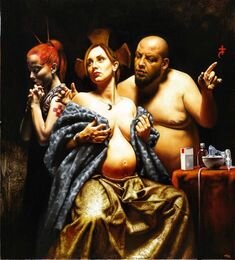
All of this is evident in the work of Saturno Buttò, who picks up on this aspect of Christian art and makes it his aesthetic. In his works the body is central. Always. And the typical composition of sacred art follows this drift, firmly riding this very contradiction, taking it to the extreme and translating it into a contemporary language. Gazes of women in mystical ecstasy or at the height of pleasure? Masturbation, pregnancy, surgical operations are just some of the moments in which Saturno Buttò portrays his figures (almost all of them female). Moments in which the body is subjected to forms of pain or pleasure, in this constant play of opposites, in which the artist's hand brings to light the contradiction and the dance between body and spirit.

Black Pills is a column that does not set out to teach anything. There are books, articles and manuals that deal with the biographies of artists, films and works of art in a detailed and exhaustive way. This is not one of those cases. The black pills are small glimpses of cultural and artistic landscapes, at times very broad, which offer the chance to explore themes that do not entirely belong to mass culture, but move along other channels and other circuits. In a world where the choice is often limited to what is defined, in the broadest sense, as pop, I highly recommend taking a few pills of a different colour and perhaps discovering something new, which in some cases, as in mine, can stay with you for the rest of your life.