
Marco Corbelli: Atrax Morgue, death through sound
Marco Mandrino
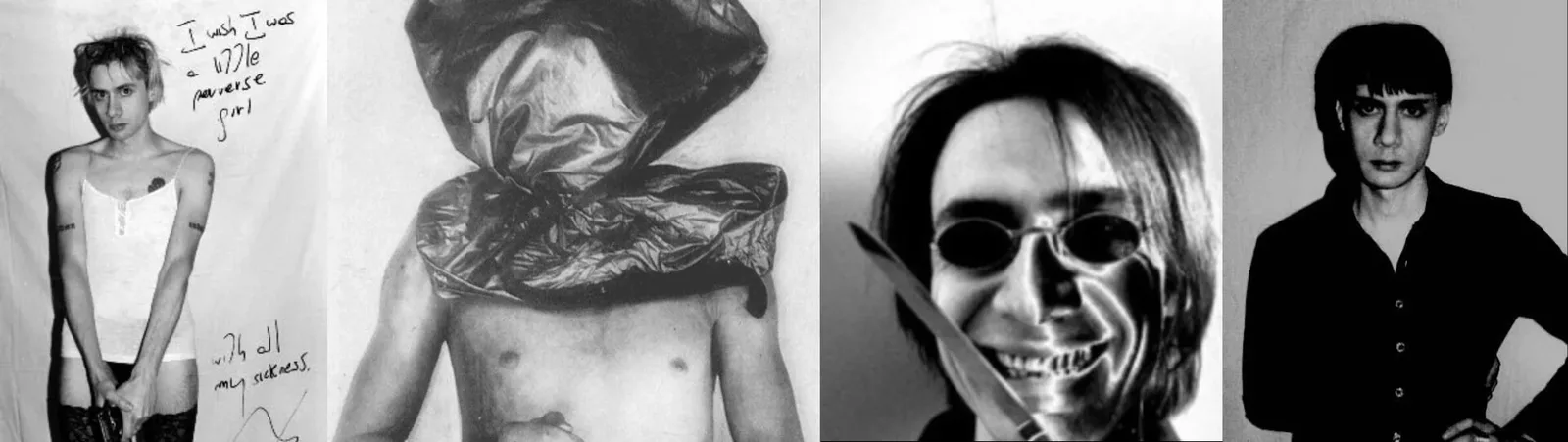
Edited by Alice Kundalini - She Spread Sorrow
Writing something about Atrax Morgue is extremely difficult for me. He is an artist whose deep worth has dug so far into me that talking about him feels almost sacrilegious. But I cannot fail to dedicate a pill to him, to his memory. Atrax Morgue is one of the leading artists of the Italian industrial scene and, I dare say, the leading one of the Italian power electronics scene. From the land of sun, pizza and mamma, we have exported one of the most extreme, controversial and disturbing musical projects ever produced. Atrax Morgue is the project of Marco Corbelli, who took his own life at the age of 37, in 2007. I had been part of that music scene myself for a few years, I was just starting out, with my first sonic experiments, and when the news reached me it literally took my breath away. I didn't know Marco, unlike some dear friends of mine who did; I had crossed paths with him only once at a concert (an edition of the Congresso Post Industriale in Prato), but among sociopaths like us (said with great affection) striking up a conversation doesn't come easily. As often happens, I kept my esteem and love for what he did to myself, and so it remained, with no chance of making up for it. After his death, his persona began to enjoy growing fame in the industrial world, both in Italy and internationally, as often happens even in more mainstream genres.
Marco has had many projects (Mörder Machine, Progetto Morte, Pervas Nefandum, etc.). Active since the early 1990s, he has worked with a great many figures of the Italian industrial scene and, with his independent label, Slaughter Productions, he produced an enormous amount of noise. These were limited-run productions, sometimes extremely limited, and the material is not easy to find, even just to listen to in digital format. They were often cassettes that travelled by post between insiders and enthusiasts, among the various characters of that scene, with an extremely fascinating way of producing and spreading music, which is the real value of what the underground was at the time: first and foremost, a community. Listening to Atrax Morgue is not easy. Of course, because the genre is absolutely abrasive and sometimes produced with limited means and on formats that lose a lot of quality, like cassettes (even if they are so fascinating). Power electronics as a whole is not easy; it is probably one of the most extreme genres in the world, where there is only noise, extremely distorted, sometimes ferocious, sometimes super minimal, at times accompanied by lyrics that are almost incomprehensible because they are completely processed with effects, and always extremely provocative, with content that is a punch in the stomach.

But listening to Atrax Morgue is not easy not only because the genre isn't, but because that sound is a direct link to something extremely deep and somehow rotten. His music doesn't talk about extreme things, it creates them. It is the sound you don't want to hear. It is so deep that it doesn't concern the ear. It concerns the gut. That is where I feel AM. His obsession with death was so deeply rooted that it is as if everything that came out of him had that particular consistency. His sound is often minimal and repetitive; it digs into you, slowly, as if it were decomposing you, as if it were gnawing at you. It often sounds like something being chewed, consumed. His music doesn't paint disturbing scenarios, his music makes terror. It puts you in touch with something deep and visceral that we don't want to see. Something extremely dirty. Sick. On top of this there is also a very strong image, which often hits just as hard as his sound, creating a complete aesthetic.

One might ask, then, why listen to something like this. The answer can only be personal: perhaps simple curiosity about something we cannot help but call unique; perhaps to discover that sound can be not music and have no words, yet communicate a great deal; perhaps because in the face of certain primordial fears we don't run away, but ask questions. Personally, I am grateful to Marco, because on his path, so authentic and painful, he often welcomed me through these sounds into a sharing of deep unease, in which black slowly becomes truly the sum of many different colours, and being able to share often helps us not to feel so terribly alone.
To listen to something, you can look for his tracks on YouTube (nothing can be found on Spotify). Finding his records is not easy, but you can still find something by searching on platforms such as Discogs.
A dear friend, an artist and producer of excellent noise as well as a great expert and enthusiast of the genre, Nicola Vinciguerra, wrote for me the article on AM that touched me most, and you can find it here.

Black Pills is a column that does not set out to teach anything. There are books, articles and manuals that deal with the biographies of artists, films and works of art in a detailed and exhaustive way. This is not one of those cases. The black pills are small glimpses of cultural and artistic landscapes, at times very broad, which offer the chance to explore themes that do not entirely belong to mass culture, but move along other channels and other circuits. In a world where the choice is often limited to what is defined, in the broadest sense, as pop, I highly recommend taking a few pills of a different colour and perhaps discovering something new, which in some cases, as in mine, can stay with you for the rest of your life.