The guide to the enchanted world: Nicoletta Ceccoli
Marco Mandrino
By Alice Kundalini - She Spread Sorrow
I have always loved fairy tales, perhaps because I have often felt I belonged less to this world and more to another one, made of stories and tales, part of an ideal archetype that lies beyond what is sometimes just banally real. And then, as people often say, there are those stories that are not "just" fairy tales, although I have never liked that kind of statement, because the world of fairy tales is never "just" anything. I understand it, it happens as adults... who knows how many important things there are to do, and there is no longer time to lose yourself in imagination.
But still, perhaps you also sometimes want to go back. And the lovely thing about fairy tales is that they always welcome you. Whenever you wish, there is a more or less enchanted or bewitched world waiting for you. The thing is, as we all know, fairy tales are not reassuring at all. In fact... if you have been away for a while, you can feel truly disoriented. So when you want to go back, do not be afraid, but if you can, have someone accompany you who can hold your hand and guide you.
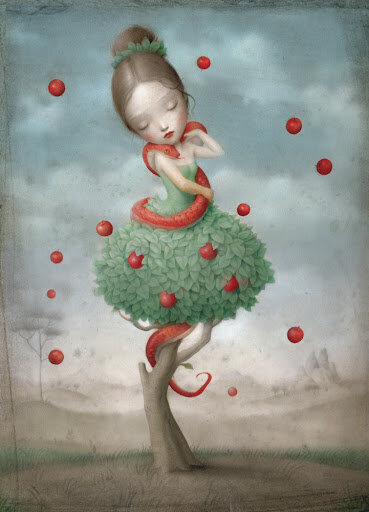
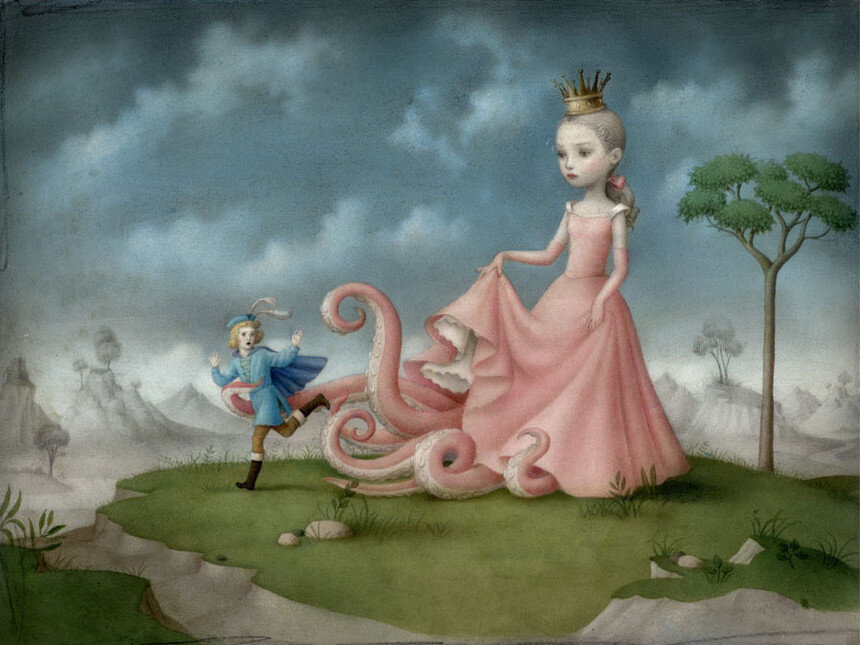
I have never strayed from the world of fairy tales, if only because almost every night my mind takes me back there through dreams or nightmares. And yet even I often look for a hand to accompany me there; the journey is even lovelier when shared. And my hand is Nicoletta Ceccoli's. She manages to draw my world of fairy tales, or rather of those that many would call "not just fairy tales". An illustrator of children's books since 1995, she has developed an aesthetic that combines the pastel colours and rounded lines typical of children's drawings with a dark, melancholic, introspective imagery, bringing to light precisely that fairy-tale world that on one hand attracts and on the other frightens.
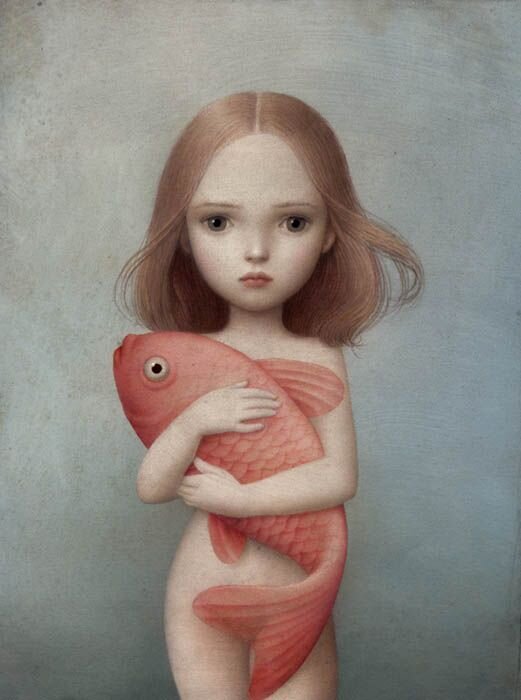
A world populated by little girls who walk mice on leads, or carry giant fish in their arms, who lick very sad ice cream cones, who eat resigned little tarts armed with big knives. An illustrator of children's books since 1995, she has developed an aesthetic that combines the pastel colours and rounded lines typical of children's drawings with a dark, melancholic, introspective imagery, bringing to light that very fairy-tale world which attracts us on the one hand and frightens us on the other. A world populated by little girls who walk mice on leads, or carry giant fish in their arms, who lick very sad ice cream cones, who eat resigned little tarts armed with big knives. On show in Cremona a few weeks ago for Affiche, an open-air exhibition stretching for almost 20 km, a controversy broke out: one of her drawings, an Alice in Wonderland holding the severed head of a rabbit, was put up in front of a middle school, and it led a few politicians to express their outrage and to exploit this artist's work, claiming that it was against children. Well, I'm sorry they were upset, but these things happen in the world of fairy tales. I mean the decapitations. These gentlemen probably haven't been back there in a long time, and I'm not even sure they would get a warm welcome, because Nicoletta is someone who is loved by a whole lot of Alices armed with great big knives. She is not an enemy for illustrating this imagery; on the contrary, she is the guide who can take us back to rediscover this enchanted world that frightens us so much, especially us adults.
She leads us with lightness, grace and poetry on a beautiful journey that every time brings us back into contact with dreams, nightmares, imagination, creativity, childhood. And that is why today's pill is for her: to thank her for accompanying me for years on so many journeys, and for knowing how to illustrate so well that world which lies not so much beyond us as within each one of us, deep down, when we let go of reason and simply fly, unafraid of blood, death, decapitations, monsters, dragons, mice, talking biscuits.... because those are not the things that should frighten us.... but ignorance, arrogance, smugness, the narrow-mindedness of some who, funnily enough, never go to that world.

Black Pills is a column that does not set out to teach anything. There are books, articles and manuals that deal with the biographies of artists, films and works of art in a detailed and exhaustive way. This is not one of those cases. The black pills are small glimpses of cultural and artistic landscapes, at times very broad, which offer the chance to explore themes that do not entirely belong to mass culture, but move along other channels and other circuits. In a world where the choice is often limited to what is defined, in the broadest sense, as pop, I highly recommend taking a few pills of a different colour and perhaps discovering something new, which in some cases, as in mine, can stay with you for the rest of your life.