
Joel Peter Witkin: the photography that shocks
Marco Mandrino
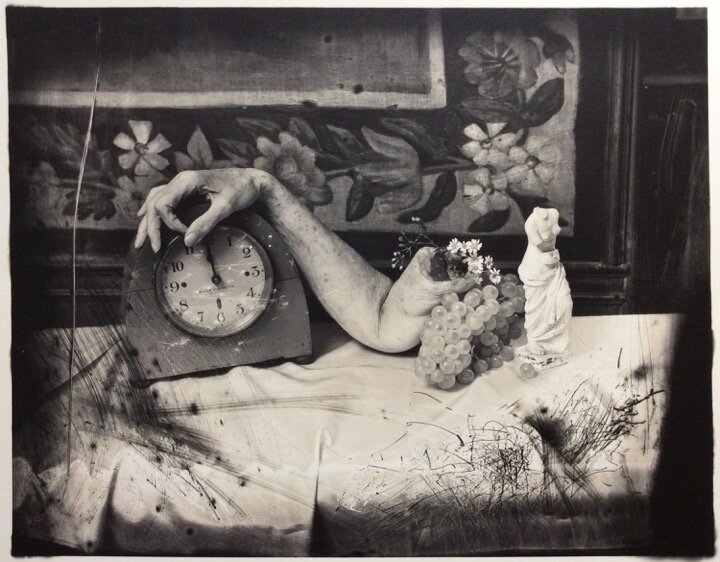
Curated by Alice Kundalini - She Spread Sorrow
Joel Peter Witkin is an American photographer born in 1939, who lives and works in Albuquerque, New Mexico. He is an extremely controversial photographer, very often censored, capable of sparking heated debate in both artistic and moral circles.
Yes, because Witkin shocks. Universally. What we can say for certain is that nobody can remain indifferent to any of his works. They cannot fail to provoke a reaction. They provoke it in everyone because Witkin tackles universal themes in a direct and immensely powerful language, with no hints or interpretations, but with extreme clarity and transparency – brutality, I would say. Though it is always a composed brutality, quite literally.
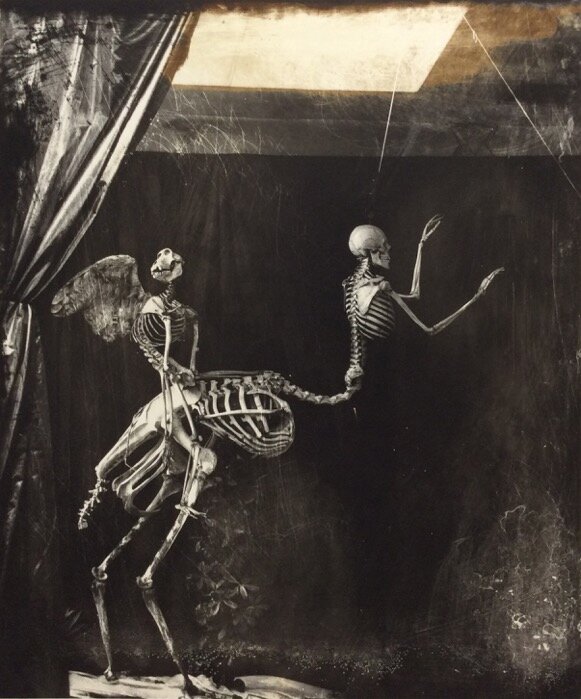
The themes he deals with are precisely the ones that make our guts twist. Not as thinking beings, but as living beings. Because the buttons Witkin presses are the atavistic ones, tied to a primitive instinct: that of being drawn to life, to beauty, to colour, to harmonious form. And instead in Witkin we find death, deformity, images with a disturbing sexual undertone, severed or amputated body parts, and all of it in a total absence of colour, in a harsh black and white, often accompanied by scratches and blemishes within the photograph. These are his themes: the transience of life and the vulnerability of the body.
Yes, Witkin shocks. Universally. In his works he recomposes surreal scenarios that are, in reality, incredibly real. Compositions created by him personally, which include flowers, fruit, animals, anatomical parts, at times severed, actual pieces of bodies, corpses, freaks, mutilated people. Well, all of it of course with an impeccable technique, which makes him an absolute master, however controversial. He says this obsession with death stems from a car accident he witnessed when he was only 7 years old, in which he saw the decapitated head of a little girl roll past in front of him. An atrocious tale of an atrocious episode, which is echoed in the atrocity of his art.
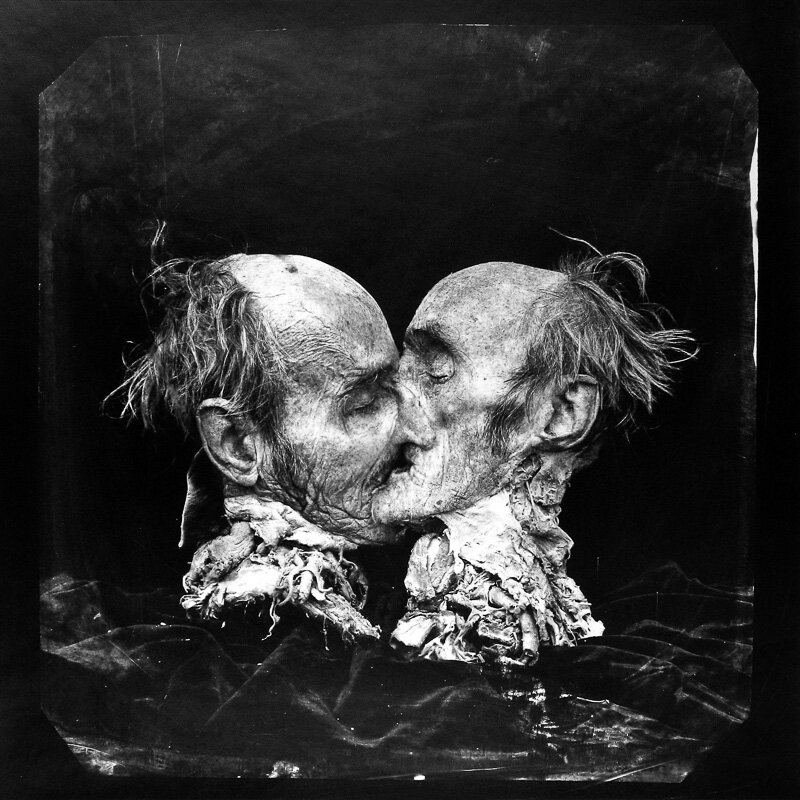
It is clear why Witkin shocks. There are many reflections to be made on the subject, starting from what we think of art and of the role of the artist. Raising profound questions and debates, even and above all within each of us, is already a great deal. Shocking, upsetting, astonishing, disturbing, touching the deepest chords of the human being is truly one of the fundamental roles of the contemporary artist. And he is truly a master at it. To provoke and not leave people indifferent, especially today, when everything seems to slide quickly off everyone. But here it is impossible not to have a strong reaction. The questions that open up in front of his works are the ones that lead a person to a much deeper degree of self-knowledge. One of his most famous works depicts two severed heads of two dead men kissing. There is no need to explain why this image is so powerful. The same goes for most of his photographs. Of course, the immediate reaction is often one of disgust. It is evident how something primitive, linked to our instinct for survival and self-preservation, makes us immediately want to reject and flee in the face of death, deformity and illness. The reaction is so strong and immediate that it instantly brings you back in touch with your attachment to life. To existence. A most powerful memento mori.
Yes, Witkin shocks. Universally. But from here, the paths one can take in front of his works are many. For many, the path stops at rejection. For some it is disdain. For some, censorship. For others, instead, it is a reason for introspection. In my opinion it would be important for everyone to analyse why we are so disturbed by his photographs.
What makes me feel so sick? Look in the dead or deformed body for those elements that disturb me, and ask myself what can be beautiful and what cannot. Why do a leg or a foot have nothing particular to say to me, yet if I see them detached from a body and resting on a table they shock me? Why can I think about death, but cannot bear to see a dead body? Why do I think it is not right to use real corpses for works of art (if I do think so)? Can that "deformed" body be considered beautiful? And what makes me call it "deformed"? Beautiful cut flowers in a vase are beautiful; are beautiful cut flowers stuck into a severed head on a table still beautiful? Cut flowers in a vase are beautiful; can a severed foot be? Is a beautiful leg always beautiful even if it is part of a body considered deformed? Or of a dead body? And amputated? Why is it fine to photograph a nude model but not an obese person or someone with amputations? On which occasions is it considered exploitation of the body, and when not? Why is it so disturbing to find sexual elements in contexts like these? What frightens me? Why does the photograph of a skull, clean and neatly arranged, not affect me much, whereas a complete head does?
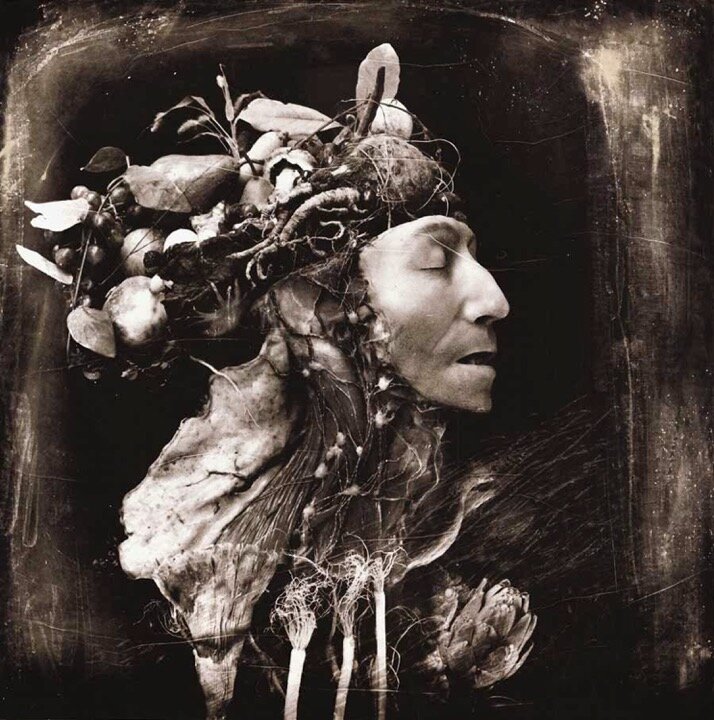
These are only some of the questions. And searching for the answer is a way of getting to know something truly profound about our own being. And while the answer is different for each of us, the common thread is attachment to life. That something sacred that makes a kiss beautiful, universally. Perhaps this is one of the reasons why, even if the first impact is repulsion, in front of his works a strange form of attraction and curiosity to see more then takes over.
In the face of death, this is what remains. The desire for life, beauty, love. Art is a celebration of what is beautiful, vital, harmonious, of what makes us happy. And although I understand that for many people it isn't possible to make this leap, for me in Witkin's art it is absolutely evident. Using an incredible aesthetic language and pushing towards the opposite, he celebrates the most important thing we have.
So yes, Witkin shocks. Universally. But I find it wonderful that he does. And I keep following him and his works because I want him to do it more and more. I want him to keep leading me to ask myself questions. To think “no, come on, this is too much, it shouldn't be done”, and then to ask myself why. And to always get to the root, ever deeper. To question paradigms taken for granted. Searching for new forms of life and beauty, where it seems to us they cannot exist.

Black Pills is a column that does not set out to teach anything. There are books, articles and manuals that deal with the biographies of artists, films and works of art in a detailed and exhaustive way. This is not one of those cases. The black pills are small glimpses of cultural and artistic landscapes, at times very broad, which offer the chance to explore themes that do not entirely belong to mass culture, but move along other channels and other circuits. In a world where the choice is often limited to what is defined, in the broadest sense, as pop, I highly recommend taking a few pills of a different colour and perhaps discovering something new, which in some cases, as in mine, can stay with you for the rest of your life.