
Japanoise: from Japan with noise
Marco Mandrino
Edited by Alice Kundalini - She Spread Sorrow
The Japanese, as we know, are second to none when it comes to flooring the accelerator on the extreme. Or perhaps their culture is so far removed from and different to ours that it simply feels that way, and in reality someone in Japan is writing exactly the same thing about Italy, but still, I'd be inclined to rule that out. And that's why so much of my inspiration comes from the Far East, whether in cinema, art or literature. And of course music.
What I'd like to do today is guide you on a journey through a landscape that, if you don't already know it, will surely leave you open-mouthed. Or at least that was the effect it had on me years ago when I discovered it. I'd like to talk to you about Japanoise. Remember, of course, that these are bite-sized pieces, so this will be a very brief introduction to a world that is incredibly vast in itself, with its origins in the 1980s, its development in the 1990s, and which is still very much active today.
The origin of the name is clear. Japan as in Japan. Noise as in noise. And indeed this is the Japanese, very personal interpretation of noise music.
In the West, noise has taken on a thousand facets over time. The best known is certainly noise rock in the style of Sonic Youth, that is, a musical style that takes typical rock idioms and fuses them with more or less distorted and violent noises. But we also have a broad electronic noise scene, which plays on the boundaries between sound, music and noise. And here the range is wide, from the more "trendy" projects, where the noises are a background that is at times secondary, to those in which noise is decidedly the master.
In your opinion, on a hypothetical noise scale where 0 is the sound of a drop falling gently into water and 10 is a pneumatic drill hammering the scorching asphalt outside your house, where does Japanoise sit? The question is deliberately ironic. From one to ten, I'd say about 100. Exactly. Japanoise is just noise, almost always without any kind of melody. But that's not all: it is the most deafening, extreme, disturbing noise you can imagine. Enough to make your ears bleed. You know when, at a concert, a deafening feedback goes off by mistake and everyone covers their ears? Well, that, but at a higher volume.

For our Japanese friends, though, this is obviously not enough. If something is extreme, it has to be extreme all the way. And by all the way, I mean right to the very bottom. And here we can't fail to mention the Hanatarash, considered the most dangerous band of all time. So much so that to attend one of their concerts you had to sign a waiver stating that you were aware that anything could happen, even death. So much so that at one gig they hired a bulldozer and used it to destroy the venue where they were playing. So much so that Yamatsuka Eye (the "singer") nearly amputated his own leg with a chainsaw he had strapped to his back.
But the Gerogerigegege are also worthy of mention when it comes to eccentricity. A duo made up of Juntaro Yamanouchi, whose role is mainly to produce noise, and Gero 30 (Tetsuya Endoh on his birth certificate), whose role is to masturbate on stage, but also to engage in even more disgusting acts, such as eating his own excrement. Let's say more or less the Japanese version of the 883 in the days of Mauro Repetto. Their masterpiece is undoubtedly Tokyo Anal Dynamite, made up of 75 tracks, practically identical, which begin with Juntaro saying the title of a song, counting in "1-2-3-4", then there's a few seconds of infernal racket and on to the next track. Oh, and of course these are covers of hugely popular songs. From Light My Fire to Boys Don't Cry.
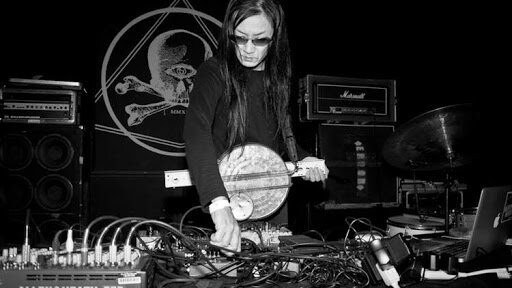
In terms of oddities, I'd also mention Merzbow (Masami Akita), the father of the genre and certainly one of its most illustrious names, who released an album in a single copy, sealed and locked inside the stereo of a BMW, which played the record every time the car was restarted. So, basically, if you wanted the record, you had to buy the car.
I've happened to see a few Japanoise concerts and even to share the stage with Merzbow himself. The first time I saw him, his live set was so violent in terms of sound that I felt nauseous for several days. Yes, the vibrations were so strong that my face was moving. But above all my guts, and my stomach in particular. It was one of the few concerts I had to watch with earplugs in, because it was unbearable (anyone who reads the Black Pills or knows me knows that I can put up with noise quite well, so this is a rather extraordinary event). When I shared the stage with him, I was in Manchester and I was opening his concert. He did at least two hours of soundcheck, which consisted of a wall of sound that was always the same and extremely violent, created with dozens and dozens of pedals. Even today it isn't clear to me what such a long soundcheck was for. A bizarre character, to say the least, he has at most one facial expression (obviously not a happy one), he doesn't speak except in cases of extreme necessity, he's been wearing a mask since long before it was fashionable (especially if he walks past a smoker), and he is extreme in his veganism and animal rights activism too, of which he is, to put it mildly, a fundamentalist supporter.
Another live show I remember was that of the Incapacitants. A duo made up of a banker and a civil servant, as well as producers of deafening noise. On that occasion one of them threw himself off the stage, landing painfully and writhing in pain, amid the more or less incredulous faces of the audience.
I'd also like to mention other fundamental projects, such as Masonna, a champion of the genre, who tends to throw himself on the floor, sometimes even from considerable heights, in a sort of dance/convulsion that is perfect to accompany the violence of his sound. Then there are projects that are slightly less extreme and certainly better known, influenced more by punk than by electronics, such as Melt Banana or the Boredoms. I'll also mention Hijokaidan, CCCC, Astro, KK Null and Zena Geva, but there are truly countless names, with many different sonic facets: some make walls of sound that are almost drone with very few variations, others produce wildly frenzied random noises, still others use the voice, and in a few rare cases we even find a sort of song form.
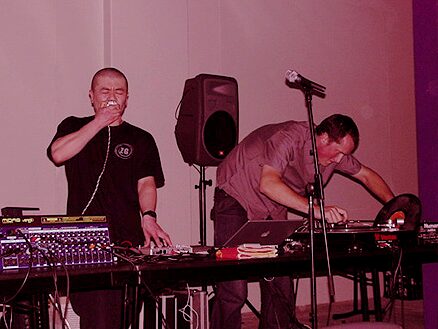
I'm almost sure I've piqued your curiosity. It isn't very easy to attend the live shows of these characters, but you'll be glad to know that in Italy there is a large band of enthusiasts of the genre who produce harsh noise, that is, extreme noise, and who offer equally enjoyable experiences. One above all: Nicola Vinciguerra, a dear old friend, who with his project Fecalove is among the best expressions of the genre on Italian soil. But also Fabrizio De Bon, known as Fukte. Here, though, another chapter opens, which I'll leave for another pill. In the meantime, who knows whether the Japanese man writing about extreme culture Italian-style will have understood what Repetto's role was in the 883.

Black Pills is a column that does not set out to teach anything. There are books, articles and manuals that deal with the biographies of artists, films and works of art in a detailed and exhaustive way. This is not one of those cases. The black pills are small glimpses of cultural and artistic landscapes, at times very broad, which offer the chance to explore themes that do not entirely belong to mass culture, but move along other channels and other circuits. In a world where the choice is often limited to what is defined, in the broadest sense, as pop, I highly recommend taking a few pills of a different colour and perhaps discovering something new, which in some cases, as in mine, can stay with you for the rest of your life.