Jan Švankmajer: surrealism on film
Marco Mandrino
Curated by Alice Kundalini - She Spread Sorrow
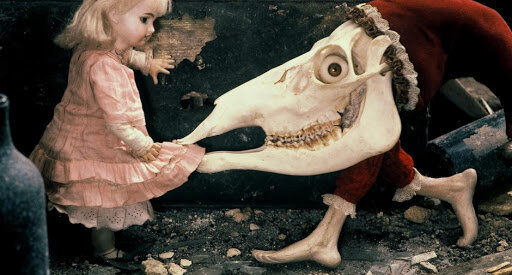
Jan Švankmajer is a Czech artist and film director born in 1934 whom, if you are lovers of the dreamlike and the surreal as I am, you cannot help but adore. His films are true masterpieces of surrealism, no question, an artistic movement of which he was an active member in the 1960s (Czechoslovak Surrealist Group). He uses a great many techniques, mainly animation, which allow him to guide us beyond the reality we are used to experiencing. Stop-motion, puppets, timelapse and much more, taking us through the language of cinema into another world: dreamlike, fairy-tale, unsettling, funny, where the laws of physics do not exist, but where communication comes across with great power, through a language that is loud and clear, above all emotionally and aesthetically.
For Jan I would like to do a different kind of pill, where I don't tell, but leave it to him and his images to take you on a journey that is fun, moving and evocative. Set reason aside and let yourselves go, ready for a true waking dream.
Let's begin by letting him introduce himself: Autoportrait (1989)
And now let's start being carried away with an excerpt from one of his most famous works. In this one minute, it moves me to tears every single time: Passionate Discourse (dimensions of dialogue).
Here you can watch Dimension of Dialogue, from which the video above is taken, one of the three dialogues that make up the short. Don't worry about the language: Jan certainly doesn't need words to show dialogues. For many, such as Terry Gilliam, this is a true masterpiece of cinema, an inspiration for him and for many other directors (Monty Python fans will easily recognise this source of inspiration).
Meat Love is truly absurd and funny: in one minute, a love story like few you will ever see:
His relationship with food comes up again and again; here is his vision of a dinner:
And of lunch:
If you have a quarter of an hour to spare, enjoy this one, which is among his most beautiful shorts: Down To The Cellar (1983)
And then, if you really want to dream, here is a whole film, his version of Alice in Wonderland, my favourite of his works. You will find it with a different soundtrack, but it is well worth enjoying in full all the same.
If you enjoyed the journey, the wonderful thing is that there is so much more of his to watch (for example, his extraordinary version of Faust). And if you have truly seen it all, don't worry: this is a journey you can take again and again a thousand times, always noticing different things and never getting bored.
Black Pills is a column that does not set out to teach anything. There are books, articles and manuals that deal with the biographies of artists, films and works of art in a detailed and exhaustive way. This is not one of those cases. The black pills are small glimpses of cultural and artistic landscapes, at times very broad, which offer the chance to explore themes that do not entirely belong to mass culture, but move along other channels and other circuits. In a world where the choice is often limited to what is defined, in the broadest sense, as pop, I highly recommend taking a few pills of a different colour and perhaps discovering something new, which in some cases, as in mine, can stay with you for the rest of your life.