
Accelerationism and electronic music: man, machine, sound
Marco Mandrino

Edited by Alice Kundalini - She Spread Sorrow
Accelerationism is a term from political philosophy, coined to describe a way of fighting the capitalist system by pushing its own characteristics to the extreme, rather than by using weapons against it. Marcuse's philosophical theory saw one of the greatest threats of the capitalist system in its ability to absorb every revolutionary form into its own logic, making it harmless and part of the system itself. Accelerationism is based on the opposite principle: put your foot down on the accelerator until we crash, to give you the idea.
But what does this have to do with music? The term was used by a well-known music critic, Adam Harper, to describe a certain artistic scene at the 2015 Berlin Music Week, where the artists present shared one characteristic: a very strong, extreme, accelerated push on what is considered one of the limits of electronic music, namely its composure, the perfection of its sound, the artificial sheen that takes the soul out of music, but doing so precisely to achieve the opposite effect, becoming something completely new and out of the ordinary.
Already with Kraftwerk (a group formed in the 1970s and still very relevant and innovative after 50 years of history), the relationship between man and machine became central: we find them turning into real robots, so that during their live shows you can't tell whether it's them, automatons or projections. Titles like Man-Machine leave no doubt about how central the question is within electronic music: machines used to create ever more crystalline, clean, logical, rational sounds... but without the blemishes of human imperfection, where do we find the soul of music?
The music now described as accelerationist keeps these themes at its centre and pushes them to the extreme within the contemporary world, where technology, machines and computers are ever more present and indispensable, not only for those who make electronic music, but for everyone. And not just that, but also the logic of the market, of advertising, of consumerism. And instead of rejecting the system, we press hard on the accelerator and see how far we can go, right up to breaking point.
By starting from the extreme version of what is supposed to be super glossy, perfect, icy, colourful, conformist, dictated by the rigid patterns imposed by technology and by the contemporary world, something completely new emerges instead, beyond the human, overcoming many labels that in reality we, as people, are the ones to impose. Genre labels, for example. What's more, this "hi-tech" music, created with the very best technology in terms of sound quality, with machines replacing musical instruments and human voices, also deals with themes we can imagine within a sort of ultra-technological digital reality made of displays and automatons... and how different is that, really, from the one we live in?

From sounds that should apparently be the most harmless, absolutely alien music emerges, with disjointed rhythms and sounds, with images and themes that go well beyond even the genres traditionally considered unconventional. And it's true: punk has been digested and no longer frightens anyone, but Far Side Virtual by James Ferraro (one of the fundamental albums of this new wave, dating back to 2011) sparked an extremely heated debate in the music world, to the point that the famous magazine The Wire, which had named it album of the year, later published a letter of apology to its readers, so much had it shocked people and caused controversy.
And alongside him, we find other wonderful artists, such as Arca, a stunning creature who transcends every definition of sex and creates incredibly profound music, famous for her productions and collaborations with Bjork.
Fka Twigs (produced by Arca), whose videos are true masterpieces, alien to everything, beyond everything. Here is the link to the first video I saw and fell in love with, but there are plenty of others just as beautiful, and perhaps even more so.
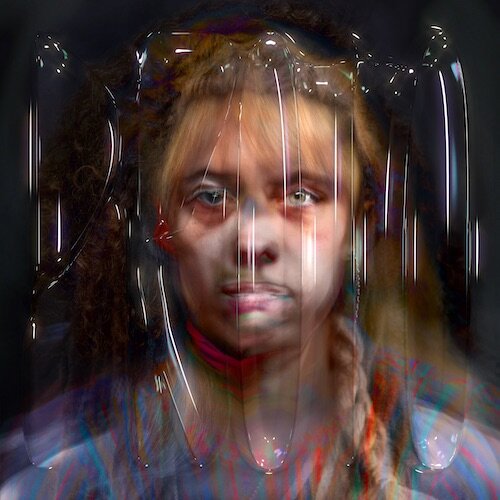
And then Holly Herndon, who for example on her latest album (Proto, from 2019) used artificially created voices that replace, overlap and contrast with her own, creating a disorienting and extremely communicative effect (don't expect a filtered voice or a Google assistant; you have to hear it to understand). I still remember her live show at the Heart Of Noise festival in Innsbruck in 2014, with an alienating video projection in which endless rows of supermarket shelves swallowed you up in their pastel colours, and the products came to life and fell in a truly unsettling hi-tech consumerist rain.
And also Oneohtrix Point Never, Logos, David Kanaga, Fatima Al Qadiri, Lorenzo Senni, Pc Music, and so on.
A world to discover, to find a different path and a break where you wouldn't expect one, and to ask ourselves what the consequences are of this total interchange that now exists between humanity and technology, finding in music and art a shared territory where the ever thinner boundaries best reveal the paradoxes of our age, in which everything has an artificial taste and a logic of consumption, with an accelerated, throwaway pace.


Black Pills is a column that does not set out to teach anything. There are books, articles and manuals that deal with the biographies of artists, films and works of art in a detailed and exhaustive way. This is not one of those cases. The black pills are small glimpses of cultural and artistic landscapes, at times very broad, which offer the chance to explore themes that do not entirely belong to mass culture, but move along other channels and other circuits. In a world where the choice is often limited to what is defined, in the broadest sense, as pop, I highly recommend taking a few pills of a different colour and perhaps discovering something new, which in some cases, as in mine, can stay with you for the rest of your life.